



The Saudi NEOM Project – a Futuristic City That Was Meant to Change Everything

The Saudi NEOM Project – Where Did the Idea Come From?
Vision 2030 and the Need to Move Beyond Oil
The Saudi NEOM project did not emerge out of nowhere. Above all, it is a direct result of the Saudi Vision 2030 program announced in 2016 by Crown Prince Mohammed bin Salman. The plan had one primary objective: to prepare Saudi Arabia for a world beyond oil.
This is an ambitious goal, given that the oil sector had for decades formed the foundation of the Saudi economy, public finances, and political stability. At the same time, Vision 2030 assumes the diversification of revenue sources and the development of industry, technology, tourism, and modern services. This is precisely why NEOM was intended to become a symbol of that transformation and proof that the country is capable of long-term thinking.
In the narrative of the Saudi authorities, the NEOM project is therefore not a luxury whim, but a necessity. On the one hand, it is meant to attract investors, foreign capital, and know-how; on the other, to create new jobs for a young society. As a result, at least in theory, it appears to be a logical response to the looming crisis of an oil-based economic model.
Why the Desert by the Red Sea?
The location of NEOM is not accidental. First, the area along the Red Sea, near the borders with Jordan and Egypt, offers access to one of the world’s key global trade routes. Second, it is a relatively sparsely populated region, which in the eyes of decision-makers makes it easier to develop a megaproject from the ground up.
Access to the sea enables the development of ports, seawater desalination, and logistics on a global scale. Moreover, proximity to Africa, Europe, and Asia aligns with the ambition to create a new trade and industrial hub. It is precisely in this context that Oxagon, the port-focused part of NEOM, emerged as a direct result of this strategic calculation.
At the same time, the desert landscape became an important element of the narrative. On the one hand, building a futuristic city in one of the harshest environments on Earth was meant to highlight the state’s technological capabilities. On the other hand, in practical terms, it meant confronting climate challenges, water scarcity, and extreme temperatures.
From Science Fiction to a Political Priority
The initial visions of NEOM resembled scenes from science fiction films. Flying taxis, an artificial moon, or cities without roads and cars were meant to symbolize a radical break from traditional models of urban development. It is therefore no surprise that these images quickly spread worldwide and became the project’s most recognizable media signature.
Over time, however, the Saudi NEOM project ceased to be merely a futuristic story. It was gradually embedded in official state documents, and its implementation was entrusted to the Public Investment Fund. As a result, the project gained strategic status, and criticism increasingly began to be treated as a political threat.
This was the moment when vision turned into obligation. From then on, NEOM became a prestige project, closely tied to the image of the crown prince. As a result, it was no longer solely about urban planning or innovation, but above all about proving that the state could impose its own definition of the future on the world.

The Line – the Heart and Symbol of the Saudi NEOM Project
A City Without Roads, Powered 100% by Renewable Energy
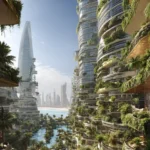
From the very beginning, The Line was meant to be the most radical element of the Saudi NEOM project. Above all, it was announced as a city completely free of roads and cars. Instead, residents were supposed to move on foot, by bicycle, and via autonomous public transport.
Crucially, the entire infrastructure was intended to be powered entirely by renewable energy. According to official declarations, solar, wind, and hydrogen energy were to create a closed, zero-emission ecosystem. In this way, The Line was meant to become a model city of the future, free from smog and noise.
At the same time, the project assumed full integration of digital technologies. In practice, this meant ubiquitous artificial intelligence, predictive systems, and automated public services. As a result, the city was supposed to respond to residents’ needs almost in real time.
A 170-Kilometer Linear Metropolis – What Life Inside Was Supposed to Look Like
The vision of The Line assumed the construction of two parallel, mirrored structures stretching over 170 kilometers. Moreover, their width was to be only 200 meters, while their height would reach 500 meters. In doing so, classical urban planning was replaced by the concept of a vertical city.
Everyday life was meant to be based on the idea of a five-minute city. This meant that schools, clinics, shops, and green spaces would all be within a short walking distance. At the same time, high-speed rail was supposed to allow travel across the entire length of the city in around 20 minutes.
Inside the structure, multi-level districts were planned, arranged in layers. On the one hand, this was intended to increase urban density; on the other, to limit the city’s expansion into the surrounding environment. In theory, it was a solution that was both ecological and functional.
When Vision Collides with Physics, Logistics, and Costs
Over time, however, serious doubts began to emerge. Above all, the scale of the project started to clash with basic laws of physics and engineering. A structure 500 meters high and stretching for 170 kilometers would require quantities of steel and concrete that significantly exceeded global production capacities.
Moreover, the costs of the project grew at a pace that was difficult to control. According to estimates, the total budget of The Line could reach trillions of dollars. As a consequence, foreign investors began to withdraw their funding, and the pace of construction clearly slowed.
The problems also concerned logistics and the city’s day-to-day operation. For example, transporting construction materials would require near-continuous deliveries, around the clock. In addition, questions arose about access to natural daylight, fire safety, and the evacuation of residents.
As a result, the original plans began to be gradually scaled back. Instead of the twenty modules announced for the first phase, discussion shifted to just a few. Therefore, The Line is increasingly seen not as a finished project, but as an extremely costly experiment at the very edge of feasibility.
The Four Faces of NEOM: The Line, Oxagon, Trojena, Sindalah
Oxagon – A Floating Industrial City and Port Automation
Oxagon represents the most pragmatic element of the Saudi NEOM project. Unlike The Line, it is not built solely on vision, but on concrete industrial and logistical functions. It is a port city designed as a trade hub connecting Asia, Europe, and Africa.
Importantly, a large part of Oxagon is being developed on water and follows a modular construction model. This allows the project to expand in stages, responding to real market demand. At the same time, the port is already operational, which clearly sets it apart from the other NEOM regions.
Automation plays a central role here. Supply chain management systems, data-driven logistics, and the ambition of zero emissions are intended to attract next-generation industry. In practice, Oxagon is an attempt to build a modern industrial zone rather than a futuristic mock-up.
Trojena – A Ski Resort and the 2029 Asian Winter Games Under Question
Trojena is the most media-driven contrast within the entire NEOM project. A ski resort located in the mountainous region of Saudi Arabia was meant to prove that technology can overcome climatic barriers. The assumption was simple: snow, ski slopes, and winter sports in a landscape dominated by desert.
At the same time, Trojena was selected as the host of the 2029 Asian Winter Games. This is a prestigious decision, but also a risky one. Construction timelines are tight, and the scale of the required sports infrastructure demands enormous investment.
As a result, questions arise about the economic rationale of the project. Although renewable energy is planned as the primary power source, the costs of building and maintaining such facilities in extreme conditions remain high. Trojena thus becomes a test of the limits between ambition and realism.
Sindalah – A Luxury Island as a “Preview” of the Entire Project
Sindalah is the region expected to deliver tangible results the fastest. The luxury island was designed as the first completed part of NEOM, open to international visitors. Its main purpose is to build a positive image for the broader project.
The offer is based on premium tourism, yachting, and high-end gastronomy. In this way, Sindalah is intended to compete with the most exclusive destinations in the Mediterranean. At the same time, it is a relatively small and more easily controllable space.
In practice, Sindalah plays a demonstrative role. It shows that NEOM can deliver a project on a limited scale. At the same time, it diverts attention from the more difficult and controversial elements of the overall initiative.
What Do These Regions Reveal About NEOM’s Real Priorities?
Comparing the four regions reveals a clear hierarchy. Projects with business or image-building potential are progressing the fastest. Oxagon and Sindalah are developing more steadily than The Line or Trojena.
This suggests that the Saudi NEOM project is gradually shifting from a vision of total transformation toward selective implementation. Instead of one unified city of the future, a set of independent initiatives is emerging, each with a different scale and risk profile.
As a result, NEOM increasingly resembles less a coherent urban model and more a portfolio of projects, where pragmatism begins to outweigh futuristic narrative.
The “Green” Promise – How the Saudi NEOM Project Uses Environmental Narratives
50 Billion Trees and the Restoration of Degraded Land
One of the strongest arguments promoting the Saudi NEOM project is its environmental narrative. Saudi authorities have announced plans to plant 50 billion trees and restore degraded land across the broader Middle East region.
According to official statements, this program is meant to stabilize soils, reduce sandstorms, and improve local microclimates. At the same time, it is expected to create new jobs and strengthen the resilience of communities affected by climate change.
In theory, these actions align with global climate goals. In practice, however, the scale of the undertaking raises serious doubts. Planting trees in one of the driest regions on Earth requires enormous amounts of water, infrastructure, and decades of continuous maintenance.
Bird Migration, a Mirrored Glass Wall, and the Risk of an Ecological Trap
The most serious environmental concerns focus on the location of The Line. The planned structure cuts across one of the world’s key bird migration routes linking Europe, Asia, and Africa. Hundreds of millions of birds pass through this corridor every year.
A mirrored façade rising 500 meters high would form an almost invisible barrier for birds. Even the use of special markings on glass does not solve the problem at a scale of 170 kilometers. As a result, the structure could become a deadly trap for many species.
Additionally, The Line blocks natural migration corridors for terrestrial animals. Habitat fragmentation and the lack of ecological crossings undermine claims that 95 percent of the surrounding environment will remain untouched.
Is a Zero-Emission Megacity in the Desert Even Possible?
Official communications emphasize that NEOM is intended to function as a zero-emission system. Renewable energy is meant to power transport, buildings, and industry. However, a full life-cycle analysis paints a far more complex picture.
Building a megacity of this scale requires vast quantities of concrete, steel, and glass. The production of these materials generates emissions that cannot be offset in the short term. Added to this are emissions linked to transportation and long-term infrastructure maintenance.
As a result, questions arise as to whether the green narrative primarily serves image-building purposes. The Saudi NEOM project may become a laboratory for new environmental technologies. At the same time, it remains a clear example of the tension between climate ambition and real environmental costs.
People, the Huwaitat Tribe, and the Dark Side of the Saudi NEOM Project
Forced Displacements and Trials of Local Residents
From the outset, the construction of NEOM has involved deep interference in the lives of local communities. The land designated for the project had been inhabited for generations by members of the Huwaitat tribe. For them, the desert was not empty space, but a place of life, work, and identity.
With the announcement of the project, forced displacements began. Residents received orders to leave their homes in the name of state interest. In practice, opposition to government decisions led to arrests and criminal proceedings.
Although official statements referred to compensation and relocation, reports from independent organizations pointed to a lack of real negotiation options. Trials of local residents were intended to have a deterrent effect, and resistance to the investment quickly ceased to be treated as a local dispute.
Death Sentences and Appeals by UN Experts
The greatest international outrage was sparked by reports of harsh sentences imposed on members of the Huwaitat tribe. According to media reports, several men were sentenced to death or long prison terms for opposing forced evictions.
The case attracted the attention of independent UN experts, who publicly expressed concern over the scale of repression. They emphasized that forced evictions cannot be treated as the most serious crimes warranting the harshest penalties.
As a result, the Saudi NEOM project began to be seen not only as an urban experiment, but also as a test of the limits of state power. The image of a city of the future increasingly collided with questions about human rights and investor responsibility.
A Smart City or a Testing Ground for Total Surveillance?
Controversies also surround the technological dimension of NEOM. The project assumes extensive use of data, artificial intelligence, and surveillance systems to manage the city. In theory, this is meant to improve service quality and security.
At the same time, cybersecurity experts warn of the risk of mass surveillance. A smart city collecting data on movement, behavior, and communication may become a tool of social control.
Additional concerns stem from Saudi Arabia’s political context and previous cases of surveillance technologies being used against government critics. As a result, NEOM is sometimes described not only as a city of the future, but also as a surveillance laboratory where the line between innovation and control remains blurred.
The Saudi NEOM Project as an Industrial and Technological Experiment
Material Scale: Steel and Cement That “Consume” Global Production
When NEOM is analyzed from an industrial perspective, the scale of material demand is impossible to ignore. The construction of The Line requires quantities of steel, concrete, and glass that at certain points exceed the annual production of entire countries. This is not a metaphor, but a real planning challenge.
According to industry analyses, building several-hundred-meter-high walls stretching across 170 kilometers would consume a significant share of global structural steel production. At the same time, cement—whose manufacturing is one of the largest sources of CO₂ emissions—becomes a critical bottleneck for the entire project.
In practice, such enormous demand affects prices, raw material availability, and timelines of other investments worldwide. NEOM ceases to be a local construction project. It becomes a factor influencing the global materials market.
Oxagon, Automation, and Green Hydrogen – A New Industrial Hub?
Against these challenges, Oxagon stands out as the most “industrially realistic” part of NEOM. The port, which is already operational, was designed with automation of logistics and production processes in mind. This is where efficiency, rather than visual spectacle, is most clearly prioritized.
Oxagon aims to become a hub for clean-energy-based industry, including the production of green and blue hydrogen. With access to the sea, renewable energy, and newly built infrastructure, the region seeks to attract companies from the chemical, energy, and technology sectors.
At the same time, questions about profitability remain. Automation, energy storage, and hydrogen infrastructure require enormous upfront investment. As a result, Oxagon is a test of whether green industry at this scale can compete with traditional manufacturing centers.
What This Megaproject Signals to Investors, Engineers, and the Construction Industry
For investors, NEOM is both a warning sign and an invitation to risk. On one hand, it offers access to state-backed capital and projects without precedent. On the other, it demonstrates how quickly vision can collide with costs and constraints.
For engineers, the project functions as a laboratory of extreme solutions. It forces design work at the edge of feasibility, often without proven reference models. This drives innovation, but also increases the likelihood of errors and costly revisions.
From the construction industry’s perspective, NEOM shows that the era of megaprojects does not eliminate limits. Even with almost unlimited budgets, physical, logistical, and environmental barriers emerge. As a result, the Saudi NEOM project becomes a case study for the entire infrastructure sector.
Where Is NEOM in 2025? Vision Versus Reality
From Twenty Modules of The Line to Three – Shrinking Ambitions
Just a few years ago, announcements surrounding The Line were unequivocal. By 2030, twenty modules of the linear city were supposed to be completed, capable of accommodating hundreds of thousands of residents. Today, those declarations belong to the past.
As implementation progressed, the plans were gradually revised. First, the number of modules was reduced to twelve, then to seven, and finally to three. Each reduction was justified as “optimization” and adaptation to real-world conditions.
In practice, this represents a fundamental change in scale. The Line is no longer the seed of a full-scale city, but instead functions as a technological demonstrator. This is a clear signal that the original vision proved too expensive and too difficult to finance.
Delays at Trojena and the Possible Rescheduling of the Winter Games
Trojena is also not developing according to its original timeline. Although construction work continues, the pace raises questions about infrastructure readiness for the Asian Winter Games planned for 2029.
Hosting a winter sporting event in a desert country was risky from the outset. Every construction delay increases logistical and financial pressure. As a result, behind the scenes there is growing discussion about the possibility of postponing the event or reducing its scale.
Trojena remains a prestige project, but also one that is costly to maintain. In effect, it becomes a test of whether image-driven ambitions can prevail over time and budget constraints.
What Has Actually Been Built: A Port, Infrastructure, and Thousands of Piles in the Sand
The most tangible results of NEOM’s implementation can be seen in Oxagon. The port has been launched and serves as the logistical backbone of the entire project. It handles the transport of materials, equipment, and workers.
Beyond the port, extensive technical infrastructure has been developed. This includes access roads, worker housing facilities, a regional airport, and transmission networks. These elements no longer raise doubts about their physical reality.
At the same time, the landscape is marked by thousands of foundation piles driven into the desert ground. They are a physical trace of The Line’s ambitions, but also a symbol of a project suspended between vision and execution. In 2025, NEOM exists more as infrastructure and preparation than as a city of the future.
What Does the Saudi NEOM Project Teach Us? Between Warning and Inspiration
The Limits of Megaprojects – When Vision Becomes Systemic Risk
The story of NEOM shows that even the largest budget does not eliminate real-world constraints. Megaprojects that ignore logistical, material, and social scale quickly begin to generate risks that go far beyond the investment itself.
In NEOM’s case, the risks are not limited to delays or cost overruns. They also include supply chain disruption, pressure on global raw material markets, and social tensions. When a project of this magnitude begins to wobble, its consequences are felt by external actors as well.
This is the point where vision stops being inspiration and becomes systemic risk. NEOM reminds us that scale must go hand in hand with controllability, and ambition with phased implementation.
How NEOM Changes the Debate on Cities of the Future and the Role of Technology
Despite its many challenges, NEOM has had a real impact on the global debate about urban development. It demonstrated that cities of the future do not necessarily have to grow horizontally, and that technology can radically reshape spatial organization.
At the same time, the project exposed the limits of a purely technological approach. Smart systems cannot replace daylight, natural ventilation, or social interaction. Technology can support a city, but it should not define it entirely.
In this sense, NEOM functions as a full-scale thought experiment. It forces urban planners, engineers, and decision-makers to reconsider a fundamental question: who are cities actually built for?
Lessons for Us and for Industry – What Every Investor Should Remember
From an industrial perspective, NEOM is a valuable lesson. It shows that innovation requires not only technology, but also economic, social, and environmental realism. Even the most futuristic concepts need solid foundations.
For investors, it is a reminder that scale does not replace risk analysis. State-backed projects are still subject to the laws of markets, physics, and time. A lack of early-stage corrections often leads to costly compromises later.
As a result, the Saudi NEOM project remains both a warning and an inspiration. It shows how far future-oriented thinking can go. At the same time, it reminds us that true innovation begins where vision meets responsibility.
The Saudi NEOM Project – Summary
What Is the Saudi NEOM Project?
The Saudi NEOM project is a large-scale urban and industrial megaproject developed by Saudi Arabia under Vision 2030, encompassing The Line, Oxagon, Trojena, and Sindalah.
Is NEOM Really Supposed to Be a City Without Cars and Roads?
Yes. According to the concept, The Line is designed to operate without cars, relying instead on high-speed rail and autonomous transport systems.
Why Is Saudi Arabia Building NEOM in the Desert?
The Red Sea location provides access to major trade routes, renewable energy potential, and vast space enabling a scale of development impossible in existing cities.
Is the Saudi NEOM Project Truly экологical?
NEOM aims for climate neutrality and renewable energy use, but critics point to the massive carbon footprint of construction and risks to local ecosystems.
What Stage Is NEOM at in 2025?
By 2025, the port at Oxagon and parts of the infrastructure have been completed, while The Line has been significantly reduced to just a few modules instead of the original plans.
Why Does the NEOM Project Spark International Controversy?
The controversies involve forced displacement of the Huwaitat tribe, court sentences, surveillance concerns, and the scale of environmental impact.
What Does the Saudi NEOM Project Teach Investors and Industry?
NEOM demonstrates that even the largest megaprojects must respect the limits of physics, logistics, markets, and social factors in order to remain viable.
